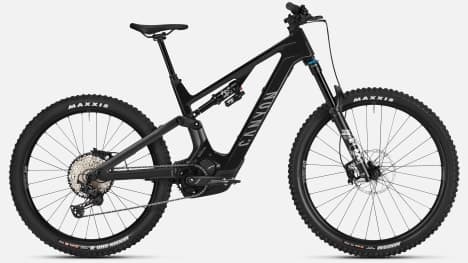
A mountain bike is the one type that fully copes with Georgian terrain, from the trails behind the Botanical Garden to the runs at Bakuriani and in Svaneti. This guide walks through every decision you need to make before buying: suspension, wheel diameter, frame size and what to actually budget.
01
What sets a mountain bike apart
A mountain bike (MTB) is defined by three things: a suspension system, wide knobbly tyres and reinforced frame geometry. Together they give you control where a road bike or an urban bike simply cannot go.
Geometry is what decides the ride, and it is what separates a modern bike from one built a decade ago. Three numbers govern the handling: head angle, reach (horizontal distance from the bottom bracket to the head tube) and stack (vertical height). A slacker head angle adds stability on descents; a longer reach adds room and composure.
Head angle - slacker means steadier on descents
Two rays from a shared point: a slack 66 degree angle and a steep 71 degree angle against the ground line.
02
Hardtail or full suspension
This is the first and most expensive decision. A hardtail has a front fork only; full suspension adds a rear shock.
A practical rule that almost always holds: for the same money, a hardtail arrives with better components. A 3,000 GEL hardtail will out-spec a full suspension bike at the same price, because the rear linkage - pivots, bearings, shock - costs 1,000-1,500 GEL on its own. Below 3,500 GEL, a hardtail is almost always the right call.
Suspension travel by discipline
Horizontal bars: XC 100-120 mm, trail 120-150 mm, enduro 150-180 mm for front and rear suspension.
Criterion
Hardtail
Full suspension
Price range
1,200 - 6,000 GEL
3,500 - 20,000+ GEL
Weight
11 - 14 kg
13 - 17 kg
Climbing efficiency
High - no energy lost
Medium - some absorbed by the shock
Descending control
Medium
High
Servicing per year
150 - 300 GEL
400 - 800 GEL (shock service)
Who it suits
Beginners, XC, tight budget
Enduro, technical trail, experienced riders
Hardtail versus full suspension, head to head
03
Wheel size: 27.5" or 29"
The difference is physics, and it is called attack angle - the angle at which the wheel meets an obstacle. The larger the diameter, the shallower that angle and the less energy the bike loses crossing a rock or a root.
Practical guidance: over 175 cm tall and riding longer distances, take 29". Under 170 cm, or if you enjoy tight, twisting singletrack, take 27.5" - it changes direction faster. There is a mullet setup in between (29" front, 27.5" rear), but it belongs mostly to the enduro class.
27.5" and 29" at the same obstacle, drawn to scale
Two wheels at true relative scale meeting the same 150 mm step; the larger wheel meets it at a shallower angle.
04
Frame material
Aluminium - the best balance of price and durability. The right answer in 90% of cases. It takes impacts and, unlike carbon, does not fail without warning.
Carbon - 1 to 1.5 kg lighter and better at damping vibration, but two to three times the price. Worth it only if you ride competitively. A rock strike is a genuine risk.
Steel - maximum comfort and effectively unlimited lifespan, but 2-3 kg heavier. Found mostly in touring and bikepacking builds.
05
Groupset and brakes
The groupset determines how precisely and quietly the gears shift. Shimano's hierarchy runs Altus → Acera → Alivio → Deore → SLX → XT → XTR. The real step up begins at Deore, which is where shifting becomes crisp and dependable even in mud. Shifters and derailleurs can also be replaced individually if you plan to upgrade.
A 1x setup (single front chainring) is now the standard: fewer parts, fewer failures, simpler to ride. You only need 2x if you regularly climb long, steep gradients under load.
Brakes are where economising pays off least. Hydraulic disc brakes work better than mechanical ones in the wet and on long descents, and take noticeably less effort at the lever. On Georgian mountain terrain that is more a safety question than a comfort one. Pads are consumable and get replaced once or twice a season.
06
How to choose your bike size
The wrong size is the most common and most expensive mistake, and no upgrade will fix it. Frame size follows your height, but the final check needs no tools: standing over the frame, there should be 5-8 cm between you and the top tube.
If you fall between two sizes: take the smaller one for active, technical riding (more agile) and the larger one for distance (more composed). Swapping the stem later adjusts fit by ±20 mm; frame size cannot be changed at all.
Frame size by rider height
Band scale: XS 150-160, S 160-170, M 170-178, L 178-186, XL 186+ centimetres.
Height
Frame
In inches
Recommended wheel
150 - 160 cm
XS
13 - 14"
27.5"
160 - 170 cm
S
15 - 16"
27.5" or 29"
170 - 178 cm
M
17 - 18"
29"
178 - 186 cm
L
19 - 20"
29"
186 cm and above
XL
21"+
29"
MTB frame sizes by rider height
07
What to budget
In the MTB market, price maps directly onto component quality. The ranges below reflect the real Georgian market, inclusive of VAT and official warranty.
Budget
What you get
Who it suits
1,200 - 2,000 GEL
Aluminium hardtail, Altus/Acera, mechanical or entry hydraulic brakes
Beginners riding once or twice a week
2,000 - 3,500 GEL
Deore 1x, hydraulic brakes, a decent fork (RockShox Judy / SR Suntour)
Regular trail riding, the right place to start
3,500 - 6,000 GEL
SLX/XT, adjustable fork, dropper post
Serious trail riding, enduro
6,000 GEL and up
Carbon, XT/XTR, high-end suspension
Racing and performance riding
Price bands and what they buy
08
Cheap bikes - what is actually possible
In Georgia most people search for a bike by price: "bikes for 300 lari", "cheap bike". The answer has to be direct, because the wrong expectation is how people lose money.
300-600 GEL - no new branded mountain bike exists at this price. This is the market-stall or second-hand range. Such a bike typically has a non-adjustable fork, unbranded brakes and a frame you cannot get spare parts for. After the first serious trail, the repair costs more than the bike.
600-1,200 GEL - here you can genuinely buy a good kids bike or a simple urban bike for tarmac. For mountain riding it is still below the threshold.
1,200 GEL and up - this is where an aluminium hardtail with a branded fork and disc brakes begins, one you can safely take onto a trail. If your budget is lower, a good urban bike beats a cheap MTB: it will do its job, while a cheap MTB does neither.
09
Common mistakes
Buying a frame to grow into. It is the one parameter you cannot fix later. An oversized bike handles worse and raises your injury risk.
Mechanical disc brakes to save money. On long mountain descents your hand tires and braking force drops. Converting to hydraulic later costs 400-700 GEL.
An unbranded fork. If the fork carries no manufacturer name, it is almost certainly non-adjustable and will lose its function within a season or two. Spare parts will not exist either.
Ignoring tyre pressure. The right range for MTB is 1.8-2.2 bar. At 3 bar you lose grip on the trail; at 1.5 bar you risk damaging the rim.
Full suspension on a minimum budget. Below 3,500 GEL the rear shock will not be any good, and the bike ends up worse overall than a hardtail.
10
Where to ride in Georgia
In Tbilisi, the trails around the Botanical Garden and on Mtatsminda are the most accessible start - technical climbs and fast descents twenty minutes from the centre. The routes around Lisi and Turtle Lake are gentler and better for beginners.
Outside Tbilisi, Bakuriani runs as a full bike park through the summer, and in Svaneti the trails around Mestia - particularly towards the Koruldi Lakes - are genuinely world class. In both cases full suspension and a dropper post make a real difference.
11
Maintenance: what and when
Before every ride: tyre pressure (1.8-2.2 bar) and a brake check. Thirty seconds.
Every 200 km, or after any muddy ride: clean and lubricate the chain. A worn chain destroys the cassette with it.
Every three months: index the derailleurs, torque the bolts properly, check the wheels.
Once a year: fork service (oil and seals), plus a bottom bracket and bearing check.
Checklist: what to verify before you buy
Frame size - 5-8 cm of clearance between you and the top tube.
Brakes - hydraulic discs, not mechanical.
Groupset - Shimano Deore or above (or the SRAM SX/NX equivalent).
The fork names its manufacturer and states its travel (100-140 mm for trail).
Wheel diameter matches your height (see the table above).
No cracks or weld defects on the frame, especially around the head tube.
Chain and cassette show no wear - teeth are symmetrical, not hooked.
Warranty paperwork present, serial number matches the frame.
Terminology
Hardtail
A bike with front suspension only. Lighter, more efficient climbing, cheaper to maintain.
Full suspension
Front and rear suspension. More control descending, more weight and running cost.
Travel
Maximum suspension movement in millimetres. XC 100-120, trail 120-150, enduro 150-180.
Head angle
The angle of the head tube. Slacker (65-66°) means more stability on descents.
Reach
Horizontal distance from the bottom bracket to the top of the head tube. It sets how roomy the bike feels.
Dropper post
A remote-adjustable seatpost. Lets you drop the saddle before a descent without getting off the bike.
1x / 2x
The number of front chainrings. 1x is the modern standard: simple and reliable.
Boost
A wider hub standard (110/148 mm) that stiffens the wheel. Check compatibility when buying wheels.
Frequently asked questions
Which mountain bike should a beginner buy?
An aluminium hardtail on 29 inch wheels with a Shimano Deore 1x drivetrain and hydraulic disc brakes, in the 2,000-3,000 GEL range. That specification is good enough that you will not need to upgrade for two or three years, and simple enough that maintenance stays affordable.
Can I ride a mountain bike in the city?
Yes, though knobbly tyres are noisy on tarmac and cost you energy. If most of your riding is urban, simply fit smoother tyres - that is 150-250 GEL and it transforms how the bike feels. An urban or gravel bike is worth considering as an alternative.
What is the difference between XC, trail and enduro?
XC (cross-country) is light and built for climbing, with 100-120 mm of travel. Trail is the all-rounder at 120-150 mm, and it is the category most riders actually need. Enduro is built for descending at 150-180 mm and is noticeably harder work uphill.
Is a dropper post worth it?
If you ride technical singletrack, yes - it is one of the most noticeable upgrades available. Being able to drop the saddle before a descent without getting off the bike changes your control substantially. On smooth tarmac the benefit is minimal.
How long does a mountain bike last?
An aluminium frame with regular servicing lasts well over ten years. Wear parts go sooner: a chain lasts 2,000-3,000 km, a cassette roughly three chains, and brake pads once or twice a season with heavy use.
What should I check before buying?
Frame size first and foremost, brake type - insist on hydraulic, the groupset - Deore or above, and the fork brand. The full list is in the checklist on this page.
Aluminium or carbon?
Below 6,000 GEL, aluminium without question. Carbon saves 1-1.5 kg and damps vibration better, but at the same price an aluminium bike carries markedly better components. Carbon only makes sense at a competitive level.
Can I buy a mountain bike for 500 GEL?
No new branded mountain bike exists at 500 GEL - that is the market-stall or second-hand range. Such bikes usually have a non-adjustable fork and unbranded brakes, and spare parts are not available. On a 500-900 GEL budget an urban or kids bike is the sounder buy.
Can I buy a mountain bike on finance?
Yes. TBC and BOG offer 0% finance from 3 to 24 months. A 3,000 GEL bike over 12 months works out at roughly 250 GEL a month with nothing added.